Edmonton’s proposed 2027-2030 budget
Council will decide on the 2027-2030 City budget in December 2026.
- The capital budget is the cost to design and build infrastructure (rec centres, bridges etc) or obtain other longer-term assets (vehicles, tech, etc). The operating budget is the day-to-day costs: paying workers to provide services (public transit, libraries, fire department, etc), insurance, bank fees, etc. City staff propose draft operating and capital budgets that City Council then debate and vote on.
- The proposed utilities budget (waste services and some energy services) goes to the City’s Utilities Committee for debate and vote before going to Council for approval.
- Since 2022 City staff have produced a climate budget that estimates whether Edmonton is on track with climate targets (we’re not) and whether specific proposed operating and capital budget line items would increase or decrease the City’s greenhouse gas emissions. This year the climate budget also assesses whether the proposed budget would support or weaken the City’s adaptation to climate change. The climate budget is a tool to help with other budget decisions, and doesn’t require approval.
In the 2025 municipal election Working Families Edmonton detailed the issues that matter most. We want a sustainable and fair economy where everyone has safe and affordable housing, a liveable income, food security, and quality education, health, and social services; and where economic justice is prioritized. Since that election we went through the climate-influenced flooding of 2026, and exponentially increased costs of groceries and other essentials. Meanwhile Edmonton’s minimum wage remained at $15/hour (the lowest in all of Canada) while the living wage – the amount necessary to cover basics – rose to $22.65/hour; a record high number of Edmontonians lost limbs to frostbite and died from drug poisoning; and the City issued millions of dollars in fines to people who are unhoused.
The City should prioritize funding to invest in front line services, social services to increase everyone’s safety, and taking action on climate change which is a huge burden to working families. Instead the proposed operating budget would maintain the same direction that got us into the current mess, slashing the already low base funding for affordable housing and homelessness while wasting increased resources to police poverty which we can see does nothing to solve the problems facing working families.
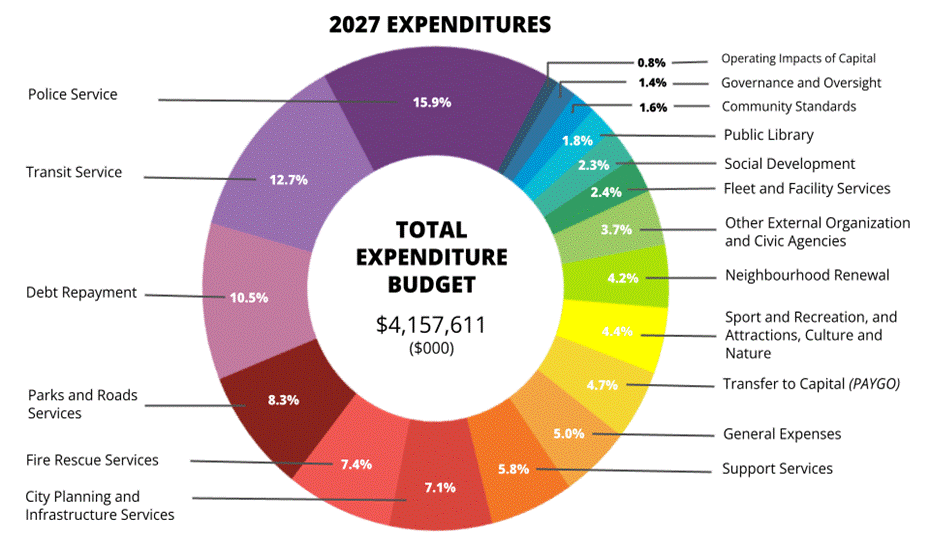
The proposed budget for capital expenses is also problematic. Capital costs are expensive and for years Councils have avoided raising taxes enough to deal with aging vehicles, buildings, etc. Procrastinating doesn’t solve anything, it just shifts the burden onto future years. Now things are bad enough for staff to warn that at the current state of the bus fleet, transit service can’t be maintained in 2027. The City needs to get real and put together a reasonable plan that will keep necessary infrastructure in good working order and help Edmonton transition to being more environmentally sustainable and socially just, with no money wasted on construction that will have minimal benefit while contributing to more devastating climate events.
Where does the money come from?
About 2/3 of the City’s budget comes from property tax. This is charged directly to people who own property, and renters pay it indirectly through their landlords. The rest comes from individuals (through user fees, transit fare, permits, etc), EPCOR and investment dividends and franchise fees, and grants from other levels of government. One way or another, the public pays for the services the City provides but by spreading it out collectively through taxes we maximize the amount available by all pitching in together.
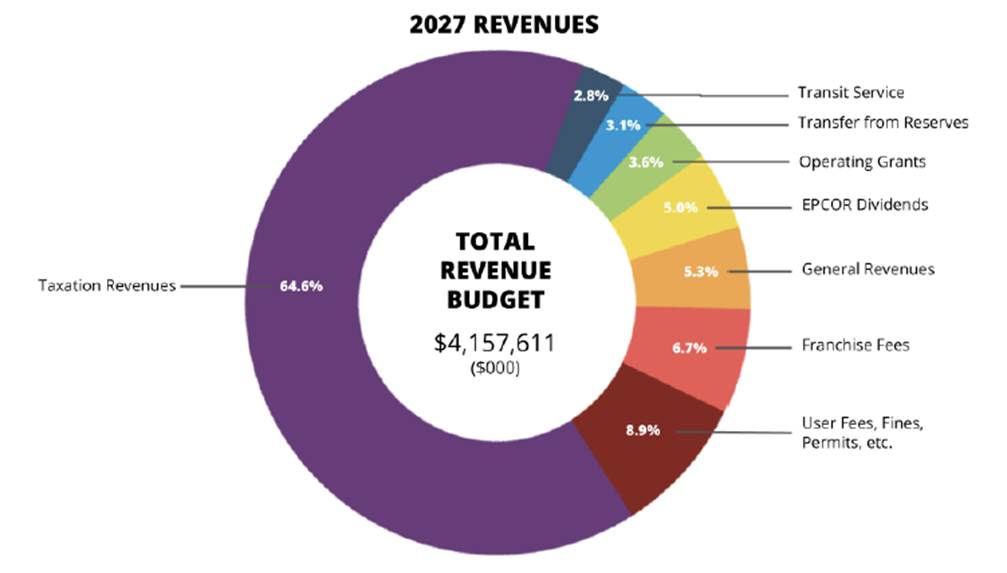
The increases in the proposed 2027-2030 budget would require property taxes to go up a small amount every year: 4.9% in 2027, 4.7% in 2028, 4.5% in 2029, and 3.9% in 2030. For 2027, this would be a monthly increase of $3.58 per $100,000 of assessed value for a residential property ($68.10 per $100,000 of assessed value for a residential property in 2027 compared to $64.52 in 2026). As an example, an Edmonton home with property assessed at $492,500 would pay $335.39 per month in 2027 compared to $317.74 in 2026 ($17.64 more in property taxes per month in 2027).
Core budget vs service packages
The City’s operating budget is set out as base funding – the basic costs to maintain what the City considers its ongoing baseline functions – and service packages that reflect one-time approval (for short-term initiatives, new or enhanced services, operational impacts of capital funding requests, etc.) that would need to be reconsidered by Council every 4 years. Service packages can be presented in the budget as funded (included in the base budget totals) or unfunded (cost estimates that would require Council approval to add them to the budget). To approve unfunded service packages Council either has to raise property taxes more to absorb that cost, or has to cut other lines to free up money to cover the cost.
Process-wise, to be considered an unfunded package has to have a Councillor move to add it, then another Councillor to second that recommendation, and then majority vote agreeing to add it. This means many of the services that we consider essential to Edmonton working families end up competing against each other for what scraps of funding are considered viable to raise through further tax increases once base budget costs are covered. It also means that it’s very important for the public to speak up for unfunded service packages you want covered, to motivate councillors to advocate for them.
What specifically do we want funded?
- Protect the base funding of the Social Development Branch of the Department of Community Services. This is the branch that is mandated to address safety, well-being, and quality-of-life challenges and foster a safe and inclusive city, focusing on affordable housing, homelessness, preventive social services, Indigenous relations, anti-racism and inclusion, community safety, violence prevention and non-profit sector support. Rather than proportionally growing this branch to address Edmonton’s population growth, compared to 2025 the proposed budget would by 2030 cut the overall branch core funding by a cumulative total of $223,009,000 (with the 2030 budget 64% of the 2025 actuals) and cut 13.6 FTEs by 2030:
- 2025 (actuals): $135,048,000 – 188.7 FTEs
- 2026 (adjusted budget): $96,276,000 – 187.6 FTEs
- 2027 (proposed): $93,954,000 – 188.1 FTEs
- 2028 (proposed): $87,627,000 – 176.1 FTEs
- 2029 (proposed): $87,120,000 – 175.1 FTEs
- 2030 (proposed): $87,254,000 – 175.1 FTEs
Every area except Indigenous Relations is cut compared to 2025 levels, with Affordable Housing and Homelessness cut the most severely (from $76,637,000 in 2025 to $34,461,000 in 2030 – a cut of more than 55%, with compounding year-over-year impacts).

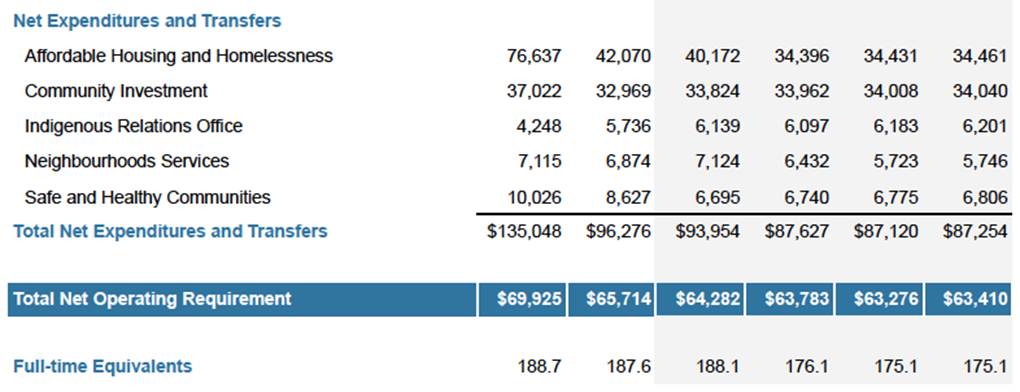
The narrative explanation of these cuts (pp. 304-305) includes the following notes:
- Affordable housing and homelessness:
- Federal Housing Accelerator Funding ($600,000) for four FTEs ends in 2026.
- The City’s obligation to fund 10% of the social housing deficit expired in 2026, resulting in ongoing “budget savings” (i.e., cuts) of $500,000 beginning in 2027.
- The City ended seven Council Committees, three of which were within the Social Development branch (Edmonton Youth Council, Anti-Racism Advisory Committee and the Women’s Advisory Voice of Edmonton), resulting in ongoing “budget savings” (cuts) of $131,000 beginning in 2027.
- A “service level adjustment” (i.e., cuts to services, although which services aren’t specified) “results in an ongoing decrease of (12.0) FTEs beginning in 2028”.
- Affordable and accessible housing. Everyone needs and deserves a place to live. A recent housing report concluded that one in ten households in Edmonton are in core housing need (are living in housing that’s unaffordable, unsafe, or overcrowded) and that if Edmonton continues with the status quo this will rise by 10,000 households by 2034. The report acknowledged that part of the problem is a mismatch in housing stock, with most housing in Edmonton being detached multi-person homes but many households being 1-2 people (and there also not being enough stock for multi-generational families). We can’t leave it up to developers to build the housing we need, but there is no government plan to tackle this. Currently affordable housing is only 0.8% of the capital budget ($48.9M) and $32.6M of that is for projects that have already been funded by the federal government, with no additional funding committed past 2027. The remaining $16.3M is for building condition assessments for 11 buildings owned by the City and managed by Civida; this is only 30% of what Civida identified as the priorities for 2027-2030 ($49.4M) and only 12% of the $136.6M Civida identified as needed to meet all deferred and planned renewal requirements. This is unacceptable, the City needs to make a strong ongoing commitment to increasing affordable housing. A serious housing plan at the scale needed to ensure everyone has adequate and affordable housing isn’t on the table right now, but there are recommendations that will make a difference. Our budget recommendations:
- Preserve as much affordable housing as possible!
- Tell Councillors to support the proposed Affordable Housing Investment Plan (AHIP) – Acquisition Grant Program service package. This is a new program aimed at giving affordable housing providers funds to leverage federal AHIP funds to buy existing market housing units that are currently rented at below-market rates (due to building age, condition, and location) and are at risk of being lost to the private sector. The service package is $3M in 2027, and the forecast is that if funded this initiative would help secure 493 units over four years.
- Tell councillors to make sure Civida has enough funds to keep all City-owned housing in good condition. The City must take responsibility for the housing it owns.
- Create more non-market, community-controlled affordable housing:
- New builds are very expensive and time-consuming, and building from scratch is more environmentally impactful than renovating existing buildings. The City hasn’t included in the proposed budget any options around expropriating currently empty buildings and renovating them to create diverse non-market, affordable housing; or mechanisms to enable overhoused people to move to more appropriate sized housing or renovate their existing housing to amplify density while maintaining privacy. Encourage the City to work with affordable housing advocates to explore options in future budgets.
- Given the scale of additional housing needed in Edmonton, new builds are still needed. Given this, encourage the City to add the $114,948,000 unfunded service package (Attachment 6 in the capital budget) to the budget, to support the acquisition of strategically located land and pre-development work on existing City-owned sites, to get them ready for new builds. This will be crucial for the City to be ready to rapidly move on federal government money that’s been announced for building new affordable housing towards ending homelessness.
- Urge the City to address the imbalance in housing stock by requiring homes be built that Edmontonians need, not leaving it to the market to build the homes that will satisfy developer desire for profit. This includes housing that reflects diverse family sizes, wheelchair accessibility and other disability access, etc.
- Make sure all new affordable housing builds are universally affordable – i.e., rent geared to income, not just slightly below market rate (which is still out of reach for many people including working families).
- Tell the City to prioritize Indigenous-designed and Indigenous-run housing, recognizing that Edmonton is on Indigenous land, that colonization created Indigenous homelessness, and that a disproportionately high number of unhoused and unsheltered people are Indigenous.
- Make sure that supportive housing (housing with on-site supports) meets diverse needs and respects resident dignity and self-determination, consistent with Housing First principles. Abstinence from substance use must not be a precondition of housing, and tenants must have a meaningful say in how their housing is run.
- Preserve as much affordable housing as possible!
- Unhoused survival services. It will take time to end homelessness, and in the meantime the City should be doing everything it can to help unhoused people stay alive and to feel supported and cared for. The proposed budget doesn’t include basics that have worked in other cities (e.g., safe storage of belongings, peer-based outreach teams that meet people where they’re at, 24/7 accessible public washrooms with staff able to do overdose prevention checks, tiny home communities, programs to ensure nobody is discharged from hospital into homelessness) and doesn’t align with recommendations by human rights experts on municipal support for people sheltering outside. Much more is needed. But there are some elements in the proposed budget that have the potential to make a positive difference. Our budget recommendations:
- It’s a serious problem that the City currently doesn’t work with the street community to ensure services are in sync with community needs, but not funding any services isn’t the solution. Instead we recommend that the City start by funding the basic service packages set out in the proposed budget, AND put in place mechanisms so going forward the street community is designing services and deciding who is trusted to run them, and services have accountability mechanisms to avoid inappropriate bans of clients and other power abuses.
- Ask Council to support the unfunded service package “Day Spaces – Community Service Hub option”. This would provide approximately $10M per year plus an initial bump of funding to build shower and laundry capacity, to create five year-round sites, operating 70 hours / week, that would include three hot meals a day, showers, laundry, on-site supports, and social and recreational activities (so people aren’t just sitting in a room with nothing to do). It is vitally important that these sites be in varied locations and set up to meet diverse needs, not be a one-size-fits-all approach; and that they be voluntary spaces that people want to be in, not warehousing people to get them out of public sight. (Unhoused people have as much right as anyone else to be in public spaces.)
- Ask Council to support the frontline service delivery components of the unfunded service package requested by REACH, to maintain 24/7 Crisis Diversion service capacity and expand winter response and add Indigenous supports. [The full $3M / year package also requests funds for data sharing and sector coordination, but we feel resources should be prioritized for immediate service needs.]
- Ask Council to support the unfunded service package “Extreme Weather – Increased Supports, including Temperature Threshold Adjustments” which would would:
- Lower the extreme cold activation threshold from -20 to -15C.
- Add approximately $775,000 per year to increase shelter capacity from 50 to 80 spaces during activations, and increase dedicated shuttle transportation to make sure anyone who wants transportation to a shelter has a way to get there. [NOTE: Data on shelter space in the winter suggests 30 additional spaces will not be enough to make sure everyone has a place to go – and the reality is not all shelters are accessible to everyone. You may want to say to Council that funding must be increased to the level needed to ensure that nobody is being turned away from shelters, that shelters are not overcrowded, that shelter residents’ dignity and privacy is upheld, and that diverse needs can be met.]
On a related note, please ask Council to uphold the recommendation by the Community & Public Services Committee that Bylaw enforcement officers be instructed not to issue tickets for people using transit for another purpose (i.e., sheltering from elements) or to ban people from accessing public transit during sub-zero temperatures.
- Ask Council to request staff work with the street community to identify budget priorities for a future adjustment process that would address currently unmet needs.
- Food security programs. It shouldn’t be solely up to charities to support people who are going hungry – adequate nutritious food is a basic human need. Food security should be considered as much part of core municipal infrastructure as wastewater treatment and roadways. But the City’s funding agreement with Sustainable Food Edmonton ended in 2025, limiting operating and small grants for urban agriculture; and at the same time the City also cut funding for City Farms, which gave volunteers space to grow produce for the Edmonton Food Bank. In 1,167 pages of operating budget food security is only mentioned once (REACH is asking for $200,000 and 2 FTEs per year to administer a program supporting grassroots and equity-led organizations to deliver free or low-cost after-school and summer programs for children and youth ages 5-24 who face barriers to participation; the request notes that without this assistance community partners anticipate fewer spaces, sites, hours, staff, food, transportation, and individualized supports; longer wait lists; and fewer safe options for families). Our budget recommendation:
- Ask the City to dedicate staff time to working with food security networks like Food Justice YEG to develop a budget adjustment that recommits City resources to supporting urban agriculture and other food security efforts. Food security needs stable, reliable funding.
- Improve infrastructure. Edmonton is still a rapidly growing municipality and it’s appropriate that the City makes sure transportation pathway repairs, snow clearing, and other basic infrastructure maintenance is happening at a level that gives everyone what they need to live and succeed. The proposed budget particularly emphasizes snow clearance of roads, consistent with feedback from public surveys. But it doesn’t do as well considering diverse modes of transportation (walking, wheelchairs and scooters, strollers, biking, public transit, driving, etc) or promoting the least environmentally harmful options and transitioning as rapidly as possible away from reliance on fossil fuels. The proposed budget also doesn’t include any infrastructure to address the drug poisoning crisis, a health emergency that in 2025 led to a record number of deaths in Edmonton. Our budget recommendations:
- Ask Council to support the unfunded service package “Assisted Snow 2027-30” that would provide $1.3M in 2027 for sidewalk and driveway snow removal assistance for up to 1,000 people, specifically low-income seniors who need help to navigate the provincial Home Services for Seniors program, and people with disabilities and those experiencing mobility issues.
- Ask Council to support the unfunded capital package CM-20-0330, Active Transportation Implementation, and related operational expenses (maintenance work related to snow removal, bike lane maintenance, bike parking, etc.) to continue the implementation of the Bike Plan, informed by the Active Transportation Implementation Guide. Ask that these funds be sufficiently flexible so they can be repurposed for other active transportation work that would improve traffic safety and support active transportation to the greatest extent possible, if the provincial government interferes with municipal governance by implementing legislation that limits the City’s ability to create new dedicated bike infrastructure.
- Ask Council to support REACH’s request for $525,000 per year for the Neighbourhood Organizing Initiative, which would provide small grants to people to organize in their neighbourhoods to address safety and well-being challenges through relationship-building, leadership development, community planning, and support for neighbourhood-led action.
- Work with people who use drugs, and frontline overdose prevention and response teams, to determine the best approaches to the drug poisoning crisis grounded in research evidence and reorienting towards support rather than punishment. This might include funding services that the provincial government is refusing to fund, expanding voluntary naloxone access and overdose response training for City staff and the general public, revising the Public Spaces Bylaw to bring responses to substance use in public spaces in line with approaches to tobacco use in public spaces, and funding improved ventilation so there can be designated spaces for smoking that improve safety and well-being for everyone.
- Fund quality transit for all. Public transit is an essential service. Making the Edmonton Transit Service robust, accessible, and fully affordable is an act of racial, social, disability, economic and climate justice. There are some improvements to public transit in the proposed budget but there are also some significant limitations. The capital budget funds only a portion of the most urgently needed replacement costs for an aging bus and light rail fleet; according to the capital budget the 2025 Infrastructure State and Condition report identified half of both the bus fleet and LRV fleet are in poor or very poor condition, such that it would cost $581.4M to fully replace all needed vehicles (and that a total investment of $186.9M in buses is needed to avoid service reductions in 2027). Additionally the proposed budget would create more financial barriers by increasing certain transit fares every year – 3-day and 5-day passes, monthly passes (including subsidized passes), U-Pass (2029 and 2030 rates TBD), and one tier of the seniors’ subsidized annual pass. Our budget recommendations:
- Address the most urgent public transit needs by funding Priority 1 in the unfunded capital profile, $200M for bus fleet and equipment rehabilitation and replacement.
- Ask Council to work with the Edmonton Transit Services to identify a realistic schedule needed for future transit work to avoid reduction of bus service and address the city’s growth, rather than trying to avoid this issue (which just makes it a more serious problem later).
- Ask Council to instruct the Edmonton Transit Service not to raise the fees for any subsidized transit passes.
- Mitigate climate damage as much as possible. The proposed budget doesn’t fully fund implementation of many of the climate action items the City recently adopted. Edmonton is not meeting climate targets and is blowing through the city’s carbon budget; more work is needed to ensure Edmonton is doing its fair share to reduce contributions to climate change. Our budget recommendation is to fully fund the City’s approved capital and operating climate action items, including:
- Action 3: Support climate prepared and energy-efficient buildings through participation in the Canada Greener Homes Affordability Program
- Action 9: Advance the decarbonization of the bus, light-duty, and heavy-duty vehicle fleet (Option 1: Core lower-emission vehicle investment package, $13M)
- Action 10: Support resilience hubs in communities
- Action 13: Advance improvements for existing city infrastructure to improve energy efficiency and climate readiness
- Action 15: Preserve, protect, and enhance urban forest and greenery
- Action 16: Steward and safeguard natural areas
- Action 20: Advance Traditional Ecological Knowledge in land management processes
What do we want the City to reduce spending on, or not to fund?
- Decriminalizing poverty and ending the drug poisoning crisis means resources should be directed away from enforcing anti-poor, anti-drug-user laws and bylaws, to free up those resources for better alternatives that supports and provides a pathway out of poverty rather than punish vulnerable people. The City’s EPS Funding Formula (which uniquely gives police guaranteed budget increases every year, unlike anything else the City funds) restricts what Council could cut from the proposed Edmonton Police Service operating budget, but Council has some discretion – e.g., over the police capital budget requests and associated operating impacts for those items. Council also has full discretion over bylaw enforcement. We currently have the most expensive police force per capita in Canada and we are not seeing results for working families. Our budget recommendations:
- Express concern about the increases to police and bylaw enforcement budgets and state you don’t want the City funding policing and bylaw enforcement as a response to homelessness or the drug poisoning crisis.
- Ask Council to limit discretionary funding allocated to EPS, including not funding increases to policing as part of planned LRT expansions, and any capital or operating impacts of capital costs other than those that are legislated requirements.
- Tell Council you understand the police funding formula can’t be altered as part of the budget process but that you want Council to explore in 2027 an end to the funding formula, so that in future EPS goes through the same budget process as every other City department and municipally funded entity.
- Tell Council you object to provisions of the Public Spaces Bylaw that punish unhoused people for survival acts that are being done in public because unhoused people don’t have any other option, and that further stigma and myths about unhoused people and people who use substances being inherently dangerous. Ask that there be no increases for Bylaw enforcement beyond cost of inflation, and that Bylaw officers be directed by Council to stop issuing fines to people who are visibly poor, or as a response to homelessness.
- Ask that Council not fund the proposed Community Bylaw Court as community groups are exploring a simpler and cheaper administrative alternative that would support people who can’t pay for poverty-related tickets to apply to have those fines waived, without having to go to court.
- Safe public transit for all, not band aid solutions: Public transit needs to be safe for and accessible to everyone, including people who tend to be over-policed and racially profiled. Increased law and bylaw enforcement for those who cannot pay fines does not make transit safer for anyone if there is no better place for them to go. Throwing good money after bad is not logistically viable as it would be prohibitively expensive for police and bylaw enforcement officers to be everywhere on the public transit system. We need a broader and more creative approach to safety on public transit, rooted in the experiences of people who use public transit and people who experience barriers to accessing public transit, and using scarce public funds as effectively as possible. Our budget recommendations:
- Ask Council to reallocate funds to broader approaches to transit safety – which may include transit navigation helpers, properly trained and equipped staff, free training available to transit riders on harassment intervention and de-escalation, overdose prevention and response peer teams, infrastructure improvements such as better lighting, etc.
- Ask Council not to support the automatic pairing of increased bylaw enforcement officers with expanded transit capacity, including planned expansions of the LRT network via the Valley Line West and Capital Line South.
- Ask Council not to fund the proposed transit station fare gate pilot project ($2.6M capital plus associated operating expenses). This is primarily a program aimed at punishing people for fare evasion, which disproportionately affects people who can’t afford to pay transit fare let alone a fine. To reduce fare evasion, put money towards better access to deeply subsidized transit passes.
- Ask Council to reconsider expanding the Community Outreach Transit Team model, and instead supporting more diverse forms of outreach including teams that pair cultural supports with health care workers rather than law enforcement personnel (in many other cities outreach teams don’t have embedded police).